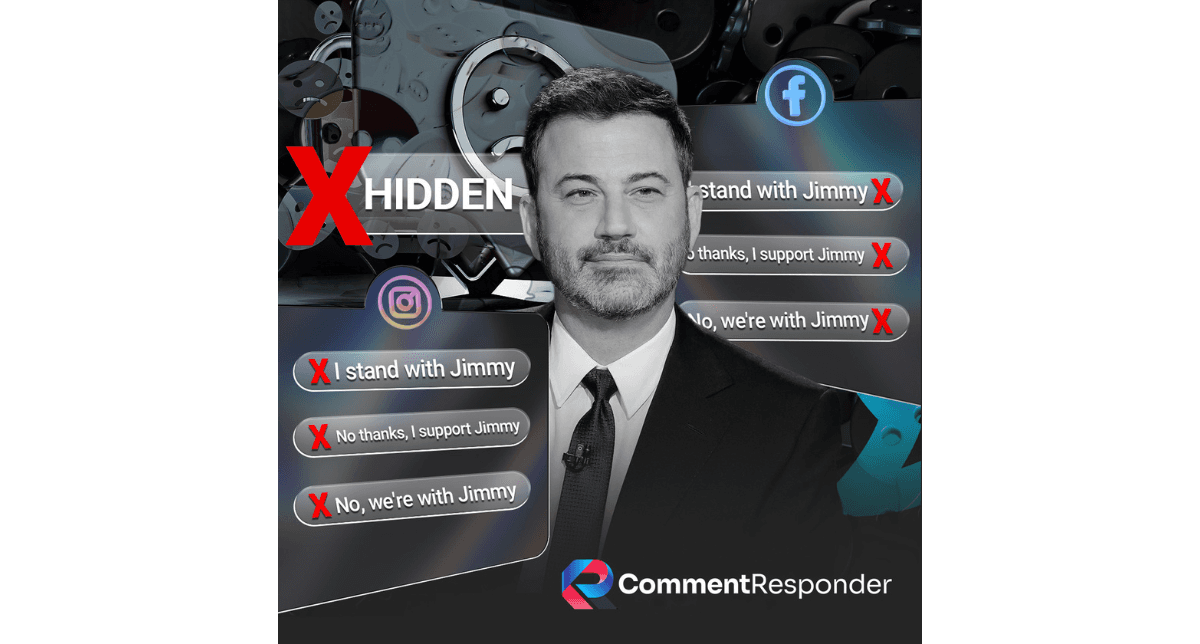
Just this week, a timely event perfectly crystallized the difference between rudimentary social media automation and true AI intelligence. Following the temporary suspension of Jimmy Kimmel, related to comments about Charlie Kirk’s tragic assassination, a surprising trend emerged across some of our CommentResponder clients’ Meta ad campaigns – specifically, those promoting Orlando vacations.
Our patent-pending Hypercognitive AI in CommentResponder began detecting comments like: “No, we’re with Jimmy” or “Stand with Kimmel.”
To a basic keyword filter, these comments might have seemed innocuous or neutral. Rudimentary sentiment analysis would have struggled, lacking context. A pre-scripted bot would have been completely stumped. Yet, our Hypercognitive AI immediately understood the nuanced, negative, and off-topic intent: a protest against Disney (the parent company of ABC, which carries Kimmel’s show), intended to disrupt our clients’ ad objectives. Due to this advanced analysis, CommentResponder instantly hid these comments, preventing a deluge of political banter completely unrelated to our client’s Orlando vacation offer from derailing the ad’s performance and comment section integrity.
This real-time scenario perfectly illustrates the Meta Comment Chaos that every brand with a substantial presence or ad spend on Facebook and Instagram faces. It’s a universal challenge where authentic engagement mixes with spam, misinformation, off-topic rants, and subtle negativity. For too long, brands have been forced to either let this chaos fester or pour unsustainable human resources into managing it.
The allure of AI for solving this is obvious, but here’s the critical distinction: many AI solutions are simply “basic bots” that fundamentally fail the “Jimmy Kimmel Test.”
The AI Promise vs. The AI Peril: Why Generic AI Isn’t Enough
Many of today’s impressive Large Language Models (LLMs) are designed to generate creative, human-like text. They excel at inference and broad knowledge. But when deployed in a customer-facing role like responding to Meta comments, this very creativity becomes a massive liability:
- Factual Errors & Misinformation: An LLM might confidently invent product features, give incorrect pricing, or cite non-existent policies.
- Off-Brand Tone: It could respond with humor when the situation demands empathy, or be overly formal when your brand is playful.
- Reputation Risk: A single hallucinated or inappropriate AI response can go viral for all the wrong reasons, undoing months of brand building in minutes.
- Regulatory & Legal Exposure: Imagine an AI giving incorrect medical advice or making false claims about a financial product. The risks are immense.
For any brand committed to authenticity and customer trust, generic AI—while powerful—is simply too unpredictable for managing direct, public customer dialogue at scale. The risk of an “off-brand” or hallucinated response is too high.
The Old Way: Limited, Clunky, and Risky — Failed by the “Jimmy Kimmel Test”
Most “automated” comment solutions fall into one or more of these categories, each with critical flaws that are starkly exposed during real-time social controversies:
- Keyword Filtering (The Blunt Instrument):
- How it works: Identifies specific words (e.g., “price,” “refund,” “bad,” “love”) to trigger an action (hide, respond).
- The Problem: It lacks contextual understanding. Imagine a customer commenting: “I love the product, but the delivery experience was so bad!” A basic keyword filter might flag “bad” as negative and trigger an apology, completely missing the positive sentiment about the product itself. Conversely, a comment like “This new feature is sick!” (meaning excellent) could be flagged as negative, leading to an inappropriate canned response or even hiding a positive review. This leads to false positives and false negatives, disrupting genuine engagement and letting harmful content linger while misinterpreting positive sentiment.
- Rudimentary Sentiment Analysis (The Binary Guess):
- How it works: Attempts to classify a comment as simply positive, negative, or neutral based on basic linguistic cues.
- The Problem: Human sentiment is complex and often ironic, sarcastic, or multi-faceted. A “rudimentary” system can’t discern these nuances. It struggles with ambiguity, slang, and cultural context. A response based on a misread sentiment can range from irrelevant to outright offensive, alienating customers.
- Structured/Pre-Scripted Messages (The Robotic Voice):
- How it works: If certain conditions or keywords are met, a pre-written, often generic, response is deployed.
- The Problem: These responses are inherently rigid and lack personalization. They can feel robotic, impersonal, and quickly expose the automation, undermining authenticity. They can’t adapt to follow-up questions or new information, leading to frustrating dead ends and a poor customer experience. They also can’t dynamically insert specific information (e.g., a specific order number from a CRM) beyond basic placeholders.
The New Way: CommentResponder’s Hypercognitive AI – Intelligent, Nuanced, and On-Brand
CommentResponder’s architecture goes exponentially beyond these basic functionalities. It’s built on a foundation of sophisticated, multi-layered AI designed for true cognitive understanding and responsive action:
- Deep Contextual and Intent Analysis (The Nuance Master):
- Beyond Keywords: Our Hypercognitive AI doesn’t just look for keywords; it understands the entire context of the comment. It can differentiate between ironic positivity and genuine negativity, identify specific questions hidden within complex sentences, and even infer user intent (e.g., “Is this product even worth it?” clearly signals purchase intent).
- Semantic Understanding: It grasps the meaning behind the words, not just the words themselves, allowing for truly relevant and appropriate responses.
- Adaptive Sentiment & Emotion Detection (The Empathy Engine):
- Beyond Binary: Our AI processes sentiment with far greater granularity, detecting nuances, sarcasm, and emotional tone. This allows it to categorize comments not just as “positive” or “negative,” but as “frustrated inquiry,” “enthusiastic endorsement,” “misinformed concern,” or “troll activity.”
- Tailored Response Strategy: This deep understanding informs the type of response needed, whether it’s a direct answer, a gentle redirection, an immediate hiding, or an escalation for human review.
- Hypercognitive Grounding & Hallucination Prevention (The Brand Guardian):
- The Core Differentiator: This is where we truly revolutionize the game. CommentResponder’s patent-pending Hypercognitive AI is rigorously grounded in your brand’s complete, verified knowledge base. It doesn’t generate responses from general internet data; it exclusively uses your product details, FAQs, terms & conditions, specific brand voice, and tone guidelines.
- Multi-AI Policing: Our unique, patent-pending architecture deploys multiple independent AI models that effectively “police” each other. One AI drafts, while others verify its factual accuracy against your knowledge base, and a third checks for brand tone and compliance. This layered verification process virtually eliminates AI hallucinations, ensuring every single response is 100% on-brand and factually correct. You never have to worry about an AI going “off-script.”
- Objective-Driven Dynamic Responses (The Strategic Conversationalist):
- Beyond Static Scripts: Responses are not pre-written templates. Our AI dynamically constructs personalized, on-brand replies in real-time, pulling relevant information directly from your knowledge base. Every reply is crafted to meet a specific business objective, whether it’s educating, converting, supporting, or mitigating.
- Adaptive Flow: It understands follow-up questions and can continue a relevant, concise conversation, mimicking a highly trained human agent but at unparalleled scale.
Does Your Automated Comment Response Pass the Jimmy Kimmel Test?
The real-world complexity of platforms like Meta demands more than just basic automation. It requires an AI that can navigate the nuances of human language, understand real-time cultural contexts, and protect your brand’s integrity and ad performance without faltering.
If your current comment management solution would have struggled or failed to correctly interpret and act upon a comment like “No, we’re with Jimmy,” then it’s clear you’re missing out on the power of truly advanced intelligence.
The difference between a clumsy, unpredictable tool and a strategic, brand-protecting, revenue-driving asset is stark. It’s time to elevate your brand’s digital conversations with intelligence that truly understands, protects, and performs, even when the unexpected happens.
Ready to ensure your AI passes the ultimate test and revolutionizes your social media engagement?