Blog
Welcome to the
ConversionIQ Revenue Machine
Every minute without autonomous engagement is revenue left on the table. Start your free trial and see results within days, not months.
 Richard Bowen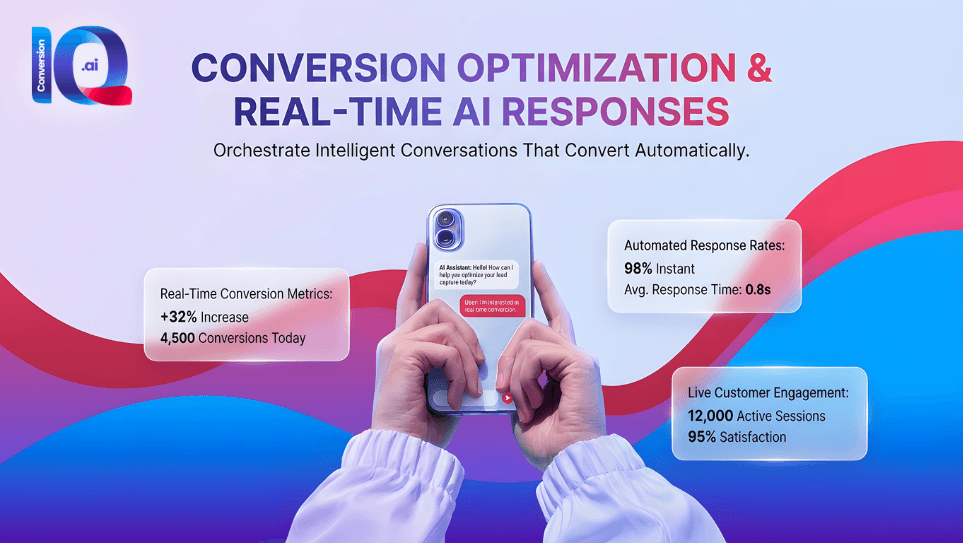
Marketing technology has evolved dramatically over the past decade. Early digital marketing tools focused on simple automation—sending scheduled emails, triggering nurture campaigns, and moving leads through predefined funnels.
These systems helped marketing teams scale repetitive tasks, but they were designed for a much simpler marketing environment.
Today, brands must respond to customers in real time across multiple channels while delivering highly personalized experiences. Customer journeys are no longer linear, and engagement happens simultaneously across websites, social media, messaging apps, and voice interactions.
Traditional marketing automation platforms struggle to keep up with this complexity.
This is where AI engines for marketing are transforming the industry.
Instead of executing static workflows, AI engines analyze behavioral data, predict customer intent, and dynamically optimize marketing interactions. These systems enable organizations to move beyond basic automation and toward intelligent, autonomous marketing infrastructure.
However, not all AI systems are created equal. Many platforms rely on a single AI model, which introduces reliability challenges such as hallucinations, inconsistent brand voice, and limited reasoning.
New systems—such as ConversionIQ’s multi-agent AI architecture—solve this by orchestrating multiple specialized AI agents that collaborate to deliver accurate, context-aware responses.
In this article, we’ll explore:
Traditional marketing automation platforms are designed to automate repetitive marketing processes through rule-based workflows.
These platforms rely on predefined triggers and actions to execute marketing tasks at scale.
For example:
Platforms like HubSpot, Marketo, Pardot, and Mailchimp have built their success around this model.
Typical marketing automation capabilities include:
These tools are effective for executing structured marketing campaigns and managing predictable customer journeys.
However, they depend heavily on manual workflow design and predefined logic.
While automation platforms revolutionized digital marketing, they were not designed to handle today’s complex, real-time customer interactions.
Automation systems require marketers to manually design every potential workflow path.
But customer behavior rarely follows predictable patterns.
If a new behavior emerges that wasn’t anticipated in the workflow design, the system cannot respond intelligently.
Most automation platforms offer basic personalization features such as:
These techniques often produce generic experiences that fail to capture real customer intent.
Automation platforms typically rely on limited data sources such as:
They rarely incorporate deeper behavioral signals or predictive analytics.
Automation platforms execute rules—but they cannot determine the best action to take in a given moment.
As marketing becomes more dynamic, this limitation becomes increasingly problematic.
An AI engine acts as the intelligence layer of modern marketing technology.
Rather than simply executing workflows, AI engines analyze data, predict customer behavior, and dynamically determine how to engage prospects.
These systems integrate multiple capabilities such as:
AI engines allow organizations to transition from automation-driven marketing to intelligence-driven marketing.
While both technologies help streamline marketing processes, they differ fundamentally in how they operate.
Automation platforms rely on predefined logic.
Example:
If a user downloads a guide → send a nurture email sequence.
AI engines analyze context and behavioral signals to determine the best action dynamically.
Example:
If a visitor demonstrates purchase intent based on browsing behavior → trigger personalized engagement immediately.
Automation systems require marketers to manually design workflows.
AI engines continuously learn from data and adapt engagement strategies in real time.
This allows AI-powered systems to optimize marketing performance without constant manual intervention.
Traditional automation platforms rely heavily on CRM and campaign data.
AI engines integrate:
This creates a deeper understanding of each customer.
Automation platforms deliver basic personalization.
AI engines deliver context-aware experiences, tailoring messaging, offers, and engagement strategies to individual customers.
While AI engines offer significant advantages, many AI-powered marketing platforms rely on a single large language model to generate responses.
This approach introduces several challenges.
If a single AI model produces an incorrect response, there is no verification layer to catch the mistake.
AI models sometimes generate confident but incorrect answers.
Without validation mechanisms, these errors may reach customers.
Single-model systems may struggle to maintain consistent tone, style, and messaging across interactions.
Many AI systems treat interactions as isolated conversations rather than part of a continuous customer journey.
These limitations have led to the emergence of multi-agent AI architectures.
Instead of relying on a single AI model, multi-agent systems deploy multiple specialized AI agents that collaborate to complete tasks.
Each agent handles a specific function, ensuring that responses are:
This approach significantly improves reliability and performance.
ConversionIQ has developed a patent-pending multi-agent AI architecture that orchestrates six specialized agents working together to manage customer engagement.
Rather than relying on a single AI model, ConversionIQ’s Autonomous Intelligence Core ensures that each response is generated, validated, and optimized through collaboration between multiple AI systems.
The platform coordinates six specialized agents:
Together, these agents form a collaborative AI system capable of delivering intelligent customer engagement at scale.
Single-model AI systems represent a single point of failure.
Multi-agent architectures introduce validation layers that significantly improve accuracy and reliability.
ConversionIQ’s system delivers measurable advantages:
This collaborative approach ensures that every interaction is strategically optimized before reaching the customer.
Each agent within ConversionIQ’s system performs a specialized role.
Together, they function as a unified marketing intelligence engine.
Maestri acts as the conductor of the entire AI system.
It determines:
This ensures efficient resource allocation and coordinated decision-making across the platform.
Chatti is responsible for generating customer-facing responses.
Unlike traditional chatbots, Chatti analyzes:
This allows the system to produce responses that guide customers toward meaningful outcomes such as purchases or support resolutions.
Dotti analyzes behavioral signals to determine the best engagement strategy.
It evaluates factors such as:
Based on these insights, Dotti determines the most effective tactic for converting visitors into customers.
Matti generates creative assets in real time across multiple channels.
This includes:
The system dynamically adapts messaging based on each customer’s profile.
Omni ensures a seamless experience across every communication channel.
Customers can engage through:
Omni maintains a unified conversation thread across all channels.
Before any response reaches a customer, Auditti performs a final validation check.
Auditti verifies:
If an issue is detected, the system automatically regenerates the response.
Every customer interaction processed by ConversionIQ flows through a structured intelligence pipeline.
A message arrives through any channel.
Omni routes the message and establishes a unified conversation context.
Matti retrieves customer history and contextual data.
Dotti analyzes behavioral signals.
Dotti determines the best engagement strategy.
Chatti generates a personalized response.
Auditti validates the response against accuracy and brand guidelines.
The validated response is delivered to the customer—typically within 800 milliseconds.
Marketing is entering a new era where automation alone is no longer sufficient.
Future marketing systems will rely on:
These systems will move beyond traditional automation and toward fully intelligent marketing infrastructure.
Traditional marketing automation platforms helped businesses scale marketing operations, but they were built for a simpler digital landscape.
Today’s marketing environment requires systems that can analyze data, predict intent, and engage customers dynamically.
AI engines represent the next evolution of marketing technology.
And as platforms like ConversionIQ demonstrate, the most reliable AI systems are those built on multi-agent architectures rather than single-model AI.
By combining strategic reasoning, conversational intelligence, content generation, cross-channel orchestration, and quality validation, multi-agent AI systems enable organizations to deliver more accurate, personalized, and effective customer experiences.
If you want to experience the future of marketing technology, explore how ConversionIQ’s Autonomous Intelligence Core can transform customer engagement.
With six specialized AI agents working together to optimize every interaction, you can deliver faster responses, smarter personalization, and more reliable automation across every channel.
Start transforming your marketing with AI-driven intelligence today. 🚀