The market for AI customer engagement split into two phases in 2026: the pilot phase (2024-2025, asking “does AI work?”) and the production-scale phase (2026-present, asking “how do we operate this at scale?”). Most brands are still in pilot mindset. Here’s what the operators actually doing this at scale are thinking about, learning from our London AI Happy Hour with 50+ founders, CEOs, and tech leaders.
Last week, we hosted 50+ founders, CEOs, CMOs, and technology leaders in London for The AI Happy Hour, an invite-only peer conversation event with no presentations, no pitches, just candid dialogue about the actual work of building and deploying autonomous customer engagement systems at production scale.
Within the first hour, a pattern emerged. Every single person in the room had moved past the pilot phase. They weren’t asking “Can AI hold a real customer conversation?” anymore. They were asking “Can our platform do it across every channel at the scale our business runs at, 24/7, without breaking?”
That’s not a difference in magnitude. That’s a categorical shift in the market.
What Is the Pilot-to-Production Shift? Definition
The pilot-to-production shift is the market transition from small-scale proof-of-concept AI customer engagement systems (processing hundreds or thousands of monthly interactions, single-channel, one language, limited integrations) to enterprise-scale production systems (processing hundreds of thousands of monthly interactions, omnichannel, multiple languages, full CRM/analytics integration, 24/7 autonomous operation).
The shift represents a fundamental change in the questions brands ask: from “Does AI customer engagement work?” (pilot phase) to “How do we operate autonomous customer engagement at the speed and scale our business demands?” (production phase).
Key differences between pilot and production AI customer engagement:
| Dimension | Pilot Phase | Production Phase |
|---|---|---|
| Scope | Small test volume | Enterprise-scale volume |
| Channels | 1–2 (usually web chat or one social channel) | Omnichannel (SMS, WhatsApp, Messenger, Instagram, Facebook, TikTok, email, web) |
| Languages | Typically one | Many, with cultural nuance |
| CRM integration | Limited or manual | Real-time, bidirectional |
| Response time | Slower, variable | Near-instant |
| Autonomy | Partial | High |
| Ownership | Single champion or small team | Dedicated operations |
The Two Phases of AI Customer Engagement: Market Evolution
We’re watching an industry inflection point happen in real time. And most brands, most agencies, most MarTech vendors haven’t caught up yet.
Phase 1: The Question Phase (2024-2025) — “Does AI Customer Engagement Actually Work?”
This was the dominant question two years ago. Enterprises were skeptical. CMOs were cautious. The proof-of-concept mindset was universal: run a small AI pilot, test it on a subset of customers, measure the results, then decide whether to invest in AI customer engagement more broadly.
The AI pilots were typically small-scale: single-channel automation (Facebook comment replies, chatbot for website FAQs, Instagram DM auto-responses). The goal was to prove the concept worked before committing significant budget or infrastructure.
Vendors optimized for this phase. They built freemium tiers, trial accounts, and proof-of-concept workflows. The entire go-to-market motion was designed around answering one question: “Should we invest in AI customer engagement?”
The market answered yes. The pilots proved the concept could work. But proving a concept and running it in production turned out to be very different things. According to MIT’s 2025 NANDA research, only about 5% of enterprise generative AI pilots achieve rapid revenue acceleration. IDC’s 2025 AI CIO Playbook found that for every 33 AI proof-of-concepts an enterprise starts, only four reach production. The demos landed. The transition to production is where most stalled.
Phase 2: The Production Scale Phase (2026 and beyond) — “How Do We Operate AI Customer Engagement at Enterprise Scale?”
The brands in the room weren’t running pilots anymore. They were operating live. Travel companies handling customer conversations across many channels and languages at once. E-commerce brands resolving the bulk of inquiries autonomously. Hospitality groups running web chat and messaging around the clock.
The pilots had already proven AI works. The focus had shifted entirely: infrastructure, economics, omnichannel integration, and operational complexity.
What Brands Got Right (And Wrong) During the Pilot Phase
The brands now winning in the production phase did two critical things during pilot phase that others missed.
1. They measured revenue impact, not engagement vanity metrics.
Most AI customer engagement pilots measure accuracy metrics: Did the AI understand the question? Did it respond appropriately? Accuracy matters technically, but it doesn’t drive business decisions.
The winners measured differently:
- Conversion lift: Did AI-assisted interactions convert at higher rates than human-handled interactions?
- Customer lifetime value: Did customers handled by AI have higher repeat purchase rates?
- Revenue per interaction: What’s the actual dollar impact of an AI-driven customer conversation?
- Cost per resolution: At what cost per interaction can AI resolve customer inquiries autonomously?
This seems obvious in hindsight. It wasn’t obvious in 2024. Most AI pilots were led by marketing or customer service teams, not revenue teams. They optimized for engagement metrics (response time, chat completion rate, customer satisfaction score) without connecting those metrics to revenue.
The brands winning now measured “Did this AI interaction lead to a sale, a retention, a higher customer lifetime value?” Those are the metrics that justify moving from pilot to production scale.
2. They built production architecture during their pilot, not after.
The brands that struggled in the transition from pilot to production built pilot systems: experiments on small datasets, limited integrations, often on a single channel.
The brands winning now asked a different question during pilot phase: “What infrastructure, what integrations, what architecture would we need if this worked and we had to handle 500,000 interactions per month in production?” Then they built that architecture, at pilot scale.
The transition from pilot to production was an acceleration, not a rebuild. They didn’t have to rearchitect once success proved the concept.
The difference: Production-ready brands started with production-ready infrastructure. They ran their pilots on systems designed to scale to 10x capacity without breaking. When results proved successful, scaling up was operational (adding capacity, training more AI agents, onboarding more channels), not architectural (rebuilding the entire system).
The Three Gaps Every Brand Faces in AI Customer Engagement Production Scale
We heard the same implementation challenges from almost every operator in the room. Three specific gaps separate “interesting pilot” from “production system” at scale.
Gap 1: The Omnichannel Integration Problem
What pilots do: Test AI on single channel (website chatbot, Facebook comments, Instagram DMs).
What production requires: Omnichannel AI customer engagement across 6-8+ channels simultaneously, with persistent customer memory across all of them.
Your customers reach you on:
- SMS
- Messenger
- Instagram DMs
- Facebook comments
- TikTok comments
- Web chat
Often in the same conversation thread: customer starts on Instagram, continues via SMS, completes on WhatsApp.
The production AI system must:
- Recognize it’s the same customer across all channels
- Maintain conversation context as the customer moves between platforms
- Route to appropriate teams/escalation paths based on channel and content
- Maintain consistent brand voice and compliance standards across every platform
- Handle channel-specific quirks (TikTok comment formatting is different from SMS; Facebook requires compliance with specific DM rules)
One CMO in the room said it plainly: “The bottleneck isn’t the AI anymore. It’s the infrastructure to connect it to everything. Building the connections is 70% of the work. The AI is 30%.”
Gap 2: The Multilingual AI Problem
What pilots do: Implement AI customer engagement in English (or one language).
What production requires: Simultaneous autonomous customer engagement in dozens of languages, with cultural and linguistic nuance.
The complexity multiplies. A question phrased in conversational Spanish is semantically different from formal Spanish. Idioms, slang, and cultural context affect how AI interprets intent.
One founder noted: “Comment moderation on TikTok in English catches obvious spam. TikTok in Portuguese requires different rules entirely. What’s spam in Portuguese slang wouldn’t flag in English keyword systems.”
Content filtering rules, brand voice parameters, and even response quality benchmarks shift by language. AI that performs well in a heavily-trained language can perform noticeably worse in a less-common one.
Gap 3: The CRM Integration and Data Sync Problem
What pilots do: Generate interesting conversations without connecting to business systems.
What production requires: Real-time bidirectional integration with CRM, sales systems, analytics, and attribution platforms.
When a customer interaction happens in production:
- CRM must know instantly: Is this person a customer? Have they purchased before? What’s their history?
- That history context must inform how AI responds (a returning customer gets different service than a prospect)
- When AI resolves an issue, CRM updates in real time
- When an interaction generates a sales opportunity, it syncs to sales system automatically
- Revenue attribution must track: Did this AI interaction contribute to the conversion? By how much?
- Every touchpoint must be analyzable for performance, ROI, and optimization
The brands struggling now built pilots that generated interesting conversations. But the conversations existed in isolation. No CRM sync. No sales follow-up. No attribution. They were proof-of-concept theater, not business systems.
Production systems treat every AI-customer interaction as a business event, not a chat log.
The Economics Change at Scale
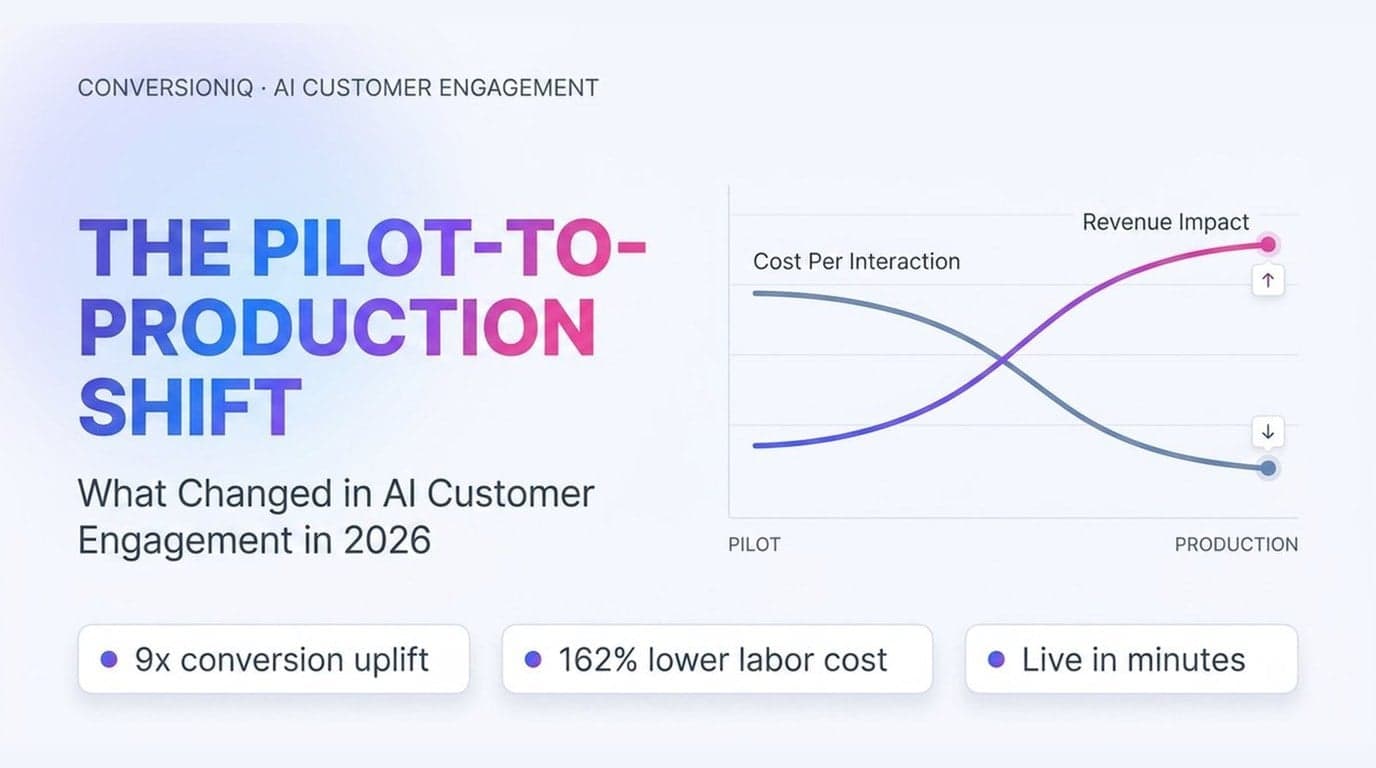
Here’s what shifts when AI customer engagement moves from pilot to production: the value equation inverts.
In a pilot, AI is usually justified as a cost saver, a way to handle routine inquiries without adding headcount. That’s a real benefit, but it’s a defensive one.
At production scale, the story changes. When AI handles the customer conversation at the moment of intent, faster responses, accurate information, no waiting, it stops being a way to save money and starts being a way to make it. Every conversation that would have been missed, delayed, or dropped becomes a chance to convert.
That’s the shift the operators in London kept describing: AI customer engagement moving from a line item in the cost column to a driver in the revenue column. Not because the technology got cheaper, but because at scale, its impact compounds across every interaction.
This is why brands are moving from pilots to production with real urgency. The economics don’t just improve. They reverse. The AI becomes strategic, not tactical.
The Staffing Question Nobody Wants to Ask
There was one question that came up in almost every conversation, usually late in the evening: “What happens to our customer service team when AI resolves the majority of inquiries on its own?”
Nobody had a clean answer. But everyone had thought about it.
The shift from pilot to production isn’t just technical. It’s organizational. The teams, the headcount, the training, the career paths that made sense when humans handled customer interactions don’t work when AI handles most of them.
The smart operators are thinking about this now. Retraining teams for higher-level work (handling escalations, building relationships, strategic accounts). Some are reducing headcount in line with AI adoption. Some are reallocating human effort to revenue-generating activities.
It’s not a smooth transition. But the brands that planned for it are executing faster than the ones that didn’t.
What’s Actually Different Now
The pilots proved AI works. That question is settled.
What’s different now is that the infrastructure, the platforms, the integrations, and the operational playbooks exist to actually run AI customer engagement at enterprise scale.
Two years ago, you were building it yourself. Now you can buy it.
That changes everything. Not just technically. But strategically.
The brands moving fastest aren’t the ones that are best at AI. They’re the ones that understood the shift was coming and planned for scale while running their pilots.
Frequently Asked Questions: Pilot vs Production AI Customer Engagement
Q: How long does it take to move from pilot to production?
A: Industry research puts the average at roughly 8 months, and even then only about half of AI projects reach production at all (S&P Global Market Intelligence, 2025). The real variable is whether you built for scale during the pilot or have to rebuild.
Q: Can we keep using our pilot system at production scale?
A: No. Pilot systems are built for small datasets, single channels, limited integrations. They will break under production load. Brands trying to scale pilots end up rebuilding anyway, costing more time and money. Start with production architecture.
Q: How many languages do we really need for AI customer engagement?
A: Start with your top customer languages, but plan for more than you think. If you’re omnichannel, customers will reach out in every language your business touches. The real answer is that your platform shouldn’t be the limit. A capable production platform should handle whatever languages you need. ConversionIQ.ai, for example, operates in 91+ languages, so language coverage never becomes the thing that caps your growth.
Q: Does running AI across more channels cost more?
A: It depends on the platform’s pricing model. Older tools often charge per channel or per seat, which punishes you for going omnichannel. Modern platforms increasingly price on usage (the volume of AI interactions) rather than the number of channels, so adding channels doesn’t multiply your bill. When you’re evaluating platforms, this is worth checking early: channel-based pricing can quietly cap how omnichannel you’re able to be.
The Market Has Shifted
We’re watching this unfold in real time. The brands that moved from “Can AI work?” to “How do we operate this at scale?” in the last 12 months are the ones winning in 2026.
For everyone else, the question isn’t whether to invest in AI customer engagement. You’ve already answered that — pilots across your organization have proven it works.
The question now is: Do you have the infrastructure, the integrations, the team structure, and the operational discipline to run AI customer engagement at production scale?
Because that’s where the market is.
The pilot phase is over. The execution phase is here.
The brands that understand this inflection are moving fast. The ones that don’t are still optimizing their pilots, not realizing the real work has already moved on.
The London AI Happy Hour started a conversation that needs to keep happening. If you’re leading AI customer engagement implementation at your organization, you’re solving some of the same problems every other operator in that room is solving: omnichannel integration, multilingual AI, CRM sync, production infrastructure, economics at scale.
The peer exchange that happened in London — the candid conversations about what works, what’s overhyped, what’s coming next — is exactly what the market needs right now.
Learn more about the AI Happy Hour Series and join the peer conversation: www.conversioniq.ai/events
We’re bringing this to more cities – next up, Mexico City in September. Whether you’re in the pilot phase or scaling production, the conversation is for you.
MIT NANDA “The GenAI Divide” (2025)
IDC / Lenovo “AI CIO Playbook” (2025)